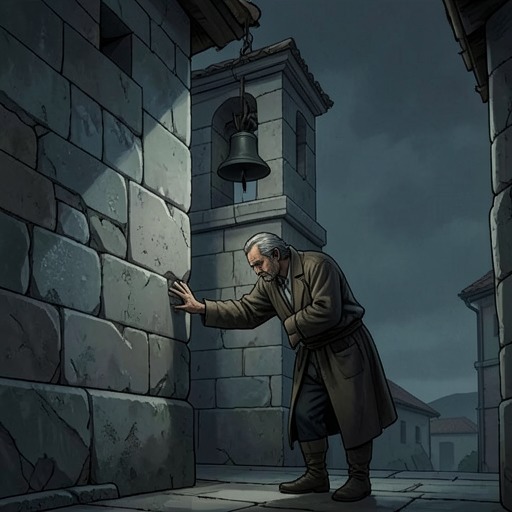
Quasimodo’s grief after Esmeralda’s execution
The Hunchback of Notre DameQuasimodo’s grief after Esmeralda’s execution is the novel’s culminating portrait of a love that has no power to restore what it cherishes. When Esmeralda is taken from Notre-Dame and executed, he searches the emptied church, confronts the likely role of Claude Frollo, and finally watches both Esmeralda’s death and Claude’s fall. His response is not a single outburst but a passage from frantic searching to wordless witnessing, ending in a lament that gathers his two attachments into one irreparable loss.
The Context of Public Cruelty
Quasimodo’s grief follows a long history of pain made public. Earlier, after his punishment at the pillory, he remained exposed to the crowd for at least an hour and a half. The spectators who had already enjoyed his appearance there grew more malicious rather than more compassionate when they saw his suffering. When he called for a drink, the crowd treated his distress as an occasion for amusement. The episode establishes a social world in which visible vulnerability can become a spectacle, and it gives the later silence of Quasimodo’s mourning a sharp contrast with the noise of public mockery.
That contrast also clarifies what Esmeralda’s death means to him. Quasimodo has been hated and ridiculed as a figure people believe they have reason to resent; his attachment to Esmeralda, by contrast, is sustained by care and gratitude. Once she is gone, the novel shows the bellringer alone with a loss the crowd cannot recognize or relieve. The pain is private, but its setting remains public: the execution at Place de Grève is visible from the towers of Notre-Dame.
The Search Through Notre-Dame
After the archers have left to pursue Esmeralda’s captors, Quasimodo searches Notre-Dame by himself. He crosses the church repeatedly, going up and down, calling out and looking into its spaces. The repeated search conveys the mind’s refusal to accept an absence as final: each circuit renews the possibility that she might still be there, while each failure makes that possibility harder to sustain.
He returns to the small cell where Esmeralda had lived under his care for weeks. Its position beneath a flying buttress, like a nest sheltered under a branch, makes it seem to him a place where she might have returned to rest or pray. He approaches cautiously, reluctant to disturb the hope he has formed. The room is empty. He looks beneath the bed before he can accept what he sees, then collapses without a cry. Later, he kisses the place where she had slept, which is still warm, and remains there before making repeated movements against the wall in an attempt to end his own life. The novel presents the sequence as an escalation from searching, to stunned recognition, to grief expressed through action rather than speech.
For more than an hour he then sits facing the deserted cell without moving. His sobs come only at long intervals; they are silent and tearless. The image of an empty chamber makes absence concrete: it is not merely that Esmeralda cannot be found in the church, but that the space organized around her former presence has become uninhabited. The text compares his stillness to a mother seated between an empty cradle and a full coffin, joining his solitary loss to the novel’s recurring image of bereaved parenthood.
Loyalty, Recognition, and the View from the Tower
In his solitary grief, Quasimodo recalls that Claude Frollo alone had a key to the staircase leading to Esmeralda’s cell. He also remembers the archdeacon’s earlier attempts to reach her: on one occasion Quasimodo had helped, and on another he had prevented him. These memories lead him to suspect that Claude has taken her. The recognition does not immediately turn into anger. His respect, gratitude, and devotion to the priest remain so deeply rooted that the violence of jealousy and despair which he might feel toward another person becomes, in Claude’s case, an increase in sorrow.
Quasimodo later finds Claude motionless on a tower, absorbed in looking toward Place de Grève. He wants to ask what the archdeacon has done with Esmeralda, but Claude’s silence and stillness are so intense that he hesitates to approach. Instead, Quasimodo follows the direction of Claude’s gaze. From the tower he sees the gallows, soldiers, and a figure at its foot; the scene is partly obscured, but he understands that Esmeralda is there. The church, which had been the place of her refuge and his guardianship, now becomes a vantage point from which he can only witness her fate.
When Claude loses his hold and hangs over the drop, Quasimodo could reach out to draw him back. He does not look at the archdeacon. His gaze remains fixed on Place de Grève, on the gallows and on Esmeralda. This moment joins the conflict of loyalties to the final structure of his grief: the man to whom he owes obedience and gratitude is in danger, but the woman whose loss has emptied his world commands his attention. The text does not present this as a deliberate rescue attempt or as a stated judgment on Claude; it emphasizes the narrowing of Quasimodo’s attention around the one object that still matters to him.
The Final Lament
Quasimodo remains at the balustrade, silent, while tears stream from the eye that, until then, had shed only one tear. That change gives his grief a visible form without making it eloquent: after long stretches in which he cannot speak, his body bears witness through tears. He watches Claude fall and then looks again toward Esmeralda, whose body hangs beneath the white of her robe. His final words express that he has lost all he ever loved. The lament brings the two figures together, not as equivalent relationships but as the two attachments that have defined his life: the priest who raised and commanded him, and the young woman whom he protected and loved without return.
The ending leaves Quasimodo at Notre-Dame after both losses. Later that day, when officers come to collect Claude’s body from the pavement of the Parvis, Quasimodo has disappeared. The account gives no further explanation of where he goes in this passage. Its force lies in the abruptness of that absence: after searching the church for Esmeralda and finding only the empty cell, Quasimodo himself vanishes from the narrative. His grief is thus represented not as recovery or consolation, but as the collapse of the world that had been held together by his attachments to Esmeralda and Claude.